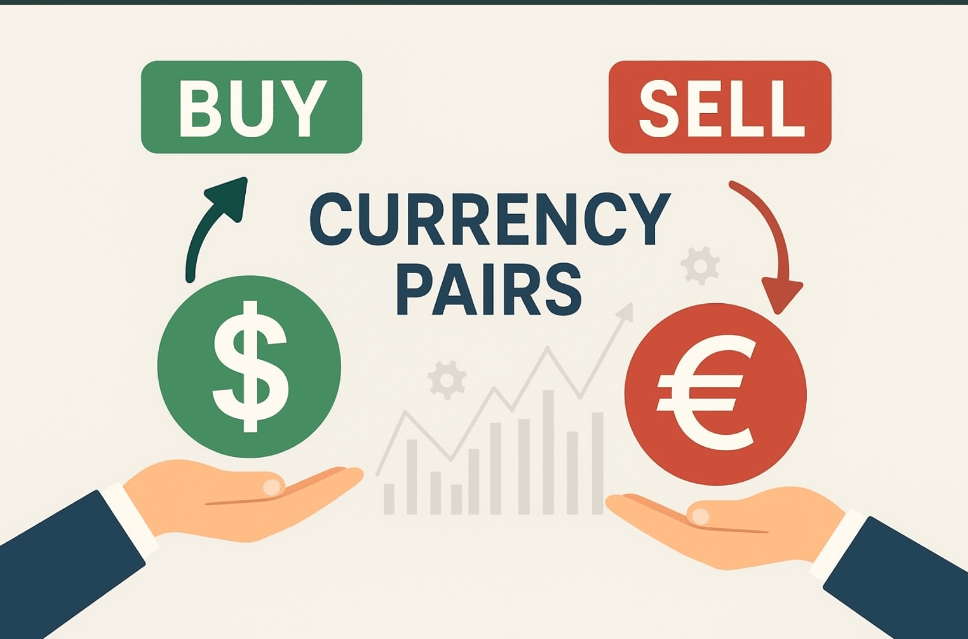
Buying and selling currency pairs is the core activity in the forex market. It’s a simultaneous transaction where you are essentially betting that one currency will either strengthen or weaken against another. Understanding the simple mechanics of this process is fundamental for any aspiring trader.
In This Post
The Core Concepts of Trading
In forex, currencies are always traded in pairs, like EUR/USD or USD/JPY. The price you see represents how much of the second currency (the quoted currency) you need to buy one unit of the first currency (the base currency).
- Going Long (Buying): When you buy a currency pair, you are buying the base currency and selling the quote currency. You do this when you anticipate that the base currency will strengthen relative to the quote currency. For example, if you buy EUR/USD, you believe the Euro’s value will increase compared to the US Dollar.
- Going Short (Selling): When you sell a currency pair, you are selling the base currency and buying the quote currency. You do this when you anticipate that the base currency will weaken relative to the quote currency. For example, if you sell EUR/USD, you believe the Euro will lose value against the US Dollar.
The Bid and Ask Prices: For every currency pair, your broker will show you two prices: the bid and the ask.
- The bid price is the price at which you can sell the base currency.
- The ask price is the price at which you can buy the base currency. The difference between these two prices is called the spread, which is essentially your broker’s commission. The smaller the spread, the less the cost of the trade.
Pips: Profits and losses in forex are measured in pips, which stand for “percentage in point.” A pip is the smallest unit of price movement. For most currency pairs, a pip is the fourth decimal place. For example, if the EUR/USD moves from 1.1250 to 1.1260, it has moved 10 pips.
Anatomy of a Trade
Let’s walk through a simple example of buying a currency pair. You are trading EUR/USD, and the current price is: 1. Bid: 1.1250 2. Ask: 1.1252
- Open Position: You believe the Euro will strengthen, so you decide to buy the pair at the ask price of 1.1252.
- Price Movement: The price moves in your favor, and the new bid/ask is now 1.1270/1.1272. The market has moved up 20 pips (1.1272 – 1.1252 = 0.0020).
- Close Position: You decide to close your trade by selling the pair at the current bid price of 1.1270.
- Profit Calculation: Your profit is the difference between your closing price (1.1270) and your opening price (1.1252), which is 0.0018, or 18 pips.
Frequently Asked Questions
What is the difference between a “long” and a “short” position?
- Going long means you expect a currency pair’s value to increase and you are buying it. Going short means you expect its value to decrease and you are selling it.
How does leverage affect profits and losses?
- Leverage allows you to control a large position with a small amount of capital. For example, 1:100 leverage means for every $1 of your own money, you can control a $100 position. It can amplify both your profits and your losses.
What is a “lot” in forex trading?
- A lot is a standard unit of trade size. A standard lot is 100,000 units of the base currency, a mini lot is 10,000 units, and a micro lot is 1,000 units. Beginners often start with micro lots due to their smaller risk exposure.
What are the most common mistakes a beginner makes when trading?
- Common mistakes include trading without a solid plan, failing to use risk management tools like stop-loss orders, overleveraging, and letting emotions like fear and greed dictate trading decisions.
Is it possible to lose more than my initial investment?
- Yes. If you use high leverage and the market moves sharply against your position, your losses can exceed your initial deposit. This is why risk management is critical.
What does it mean when a currency pair is “volatile”?
- A volatile currency pair is one that experiences rapid and significant price changes in a short period. While this can offer opportunities for high profit, it also carries a high level of risk.