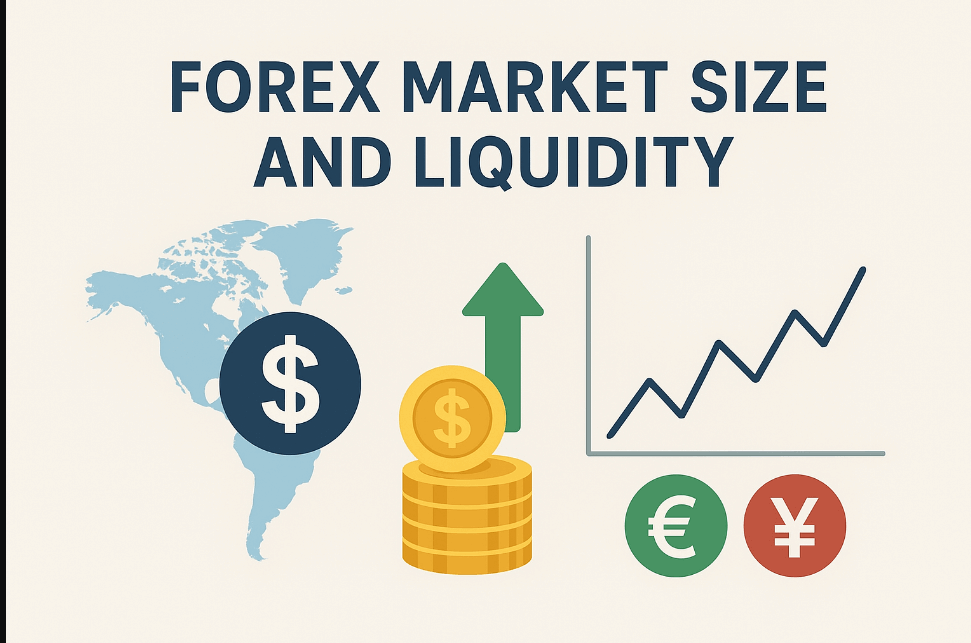
The forex market is the largest and most liquid financial market in the world. Its massive size refers to the enormous volume of money traded daily, while its high liquidity refers to the ease with which currency can be bought or sold without significantly affecting its price. These two characteristics are fundamentally linked and are the defining features of the market.
In This Post
Market Size
The sheer scale of the forex market is what makes it unique. According to recent data from April 2025, the daily trading volume of the global forex market is estimated to be over $7.5 trillion. To put that number into perspective, it is a volume far greater than the combined daily trading volumes of all the world’s stock markets, including the New York Stock Exchange and Nasdaq. This colossal size means the market is incredibly efficient and difficult for any single entity to manipulate.
Market Liquidity
In simple terms, liquidity is the ability of an asset to be converted into cash quickly and at a fair price. The forex market is highly liquid because there are always thousands of buyers and sellers at any given moment. This ensures that a trader can enter or exit a position almost instantly, with very little price impact. High liquidity leads to several key advantages for traders:
- Tight Spreads: With a large number of participants, the competition between buyers and sellers is high. This results in a very small difference between the bid (selling) and ask (buying) prices, lowering transaction costs for the trader.
- Efficient Execution: Orders are executed quickly and at the intended price, which is crucial for scalpers and high-frequency traders.
- Reduced Slippage: High liquidity minimizes slippage, which occurs when a trade is executed at a different price than the one requested.
How Big Is the Forex Market?
The forex market is the largest financial market in the world, with a daily trading volume exceeding $7.5 trillion. This figure makes it larger than all global stock markets combined.
To put it in perspective:
- The New York Stock Exchange averages about $100 billion in daily volume.
- Forex surpasses that by more than 70 times.
Why Market Size and Liquidity Matter for Traders
Understanding forex market size and liquidity is crucial for anyone entering the market:
- Accessibility: The market operates 24 hours a day, five days a week, across different time zones.
- Low costs: Tight spreads make forex trading cost-efficient.
- Opportunities for all: From central banks to retail traders, everyone benefits from high liquidity.
- Flexibility: Traders can enter or exit positions at virtually any time.
Several factors contribute to this high liquidity, including the market’s 24/5 operation, which allows traders from different time zones to always participate, and the sheer number and diversity of participants, from large commercial banks to individual retail traders. The forex market’s unmatched size and liquidity make it a unique and powerful financial arena. Whether you’re a beginner exploring trading opportunities or an experienced investor seeking diversification, forex offers depth, flexibility, and efficiency unmatched by any other market..
Frequently Asked Questions
What is the difference between liquidity and volatility?
- Liquidity is the ease of buying and selling an asset without affecting its price. Volatility is the rate at which an asset’s price fluctuates. A highly liquid market tends to have low volatility, as the large volume of trades stabilizes prices.
Does liquidity change throughout the day?
- Yes. Liquidity is highest during the overlapping hours of major trading sessions, such as when the London and New York markets are both open. It tends to be lowest on weekends or during major holidays.
How is forex market size measured?
- The market size is measured by the average daily trading volume. This data is typically collected and reported every three years by institutions like the Bank for International Settlements (BIS).
Which currency pairs are the most liquid?
- The most liquid currency pairs are the majors, which all include the US Dollar. The most liquid of all is the EUR/USD pair, as it represents the two largest economies in the world.
What is a “liquidity provider”?
- A liquidity provider is a major financial institution (like a large bank or a market maker) that acts as an intermediary, providing both buy and sell quotes for an asset to maintain market efficiency and ensure there’s always a market for a trade.
How does liquidity affect a beginner’s trading?
- High liquidity is beneficial for beginners as it offers tighter spreads, which lowers transaction costs. It also ensures that a trade can be executed quickly, reducing the risk of a beginner’s order being filled at an unexpected price.