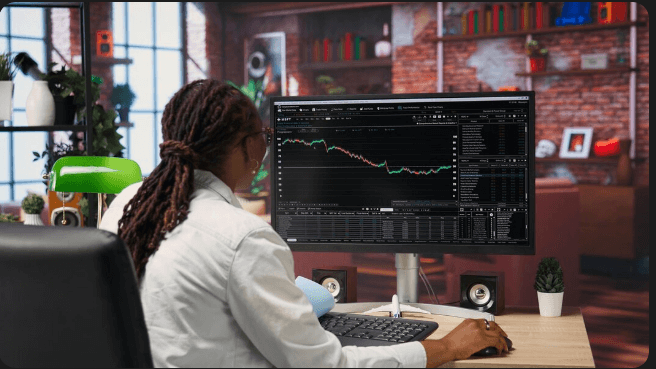
This article gives you the step-by-step guide on how to trade forex, the journey to becoming a forex trader can be broken down into a series of clear, manageable steps. While it may seem intimidating at first, the process is straightforward and requires a commitment to education and discipline. This guide will walk you through the essential stages of learning how to trade the foreign exchange market, turning a complex process into a simple roadmap.
In This Post
What Is Forex?
Forex, or foreign exchange market, is the world’s largest financial market for buying and selling currencies. Forex, unlike stock markets, does not have a centralized exchange; instead, it operates globally 24 hours a day, five days per week. Forex trading allows traders and investors to speculate on whether currency values will rise or decline. With daily trading volumes reaching $6 trillion, forex provides various options for both beginners and expert traders.
Understanding Currency Pairs
Currency quotes in forex trading are always provided in pairs. This is a result of buying one currency and selling another at the same time.
For instance:
When you purchase EUR/USD (Euro vs. US Dollar), you are selling US dollars and purchasing euros. The British pound vs the Japanese yen, or GBP/JPY. By purchasing this pair, you are placing a wager on the pound’s strength relative to the yen.
Three primary categories of currency pairs exist:
- The most traded currencies, such as EUR/USD, GBP/USD, and USD/JPY, are included in major pairs.
- Minor Pairs: EUR/GBP and AUD/JPY are examples of less traded but nonetheless popular pairs.
- Exotic Pairs: USD/TRY (US Dollar vs. Turkish Lira) is an example of a currency pair that combines a major currency with one from a smaller or emerging economy.
Step By Step Guide On How To Trade Forex
#Step 1: Master the Fundamentals
Before you place your first trade, you must learn the language of the market. This foundational step involves understanding key concepts like currency pairs, pips (the unit of price change), and spreads (the cost of a trade). You must also grasp the basics of market analysis, which includes:
- Technical Analysis: Studying charts and using indicators to predict future price movements based on past price action.
- Fundamental Analysis: Examining economic news, government policies, and other real-world events that can influence a currency’s value.
#Step 2: Choose a Reputable Broker
A forex broker is your gateway to the market, choosing the right one is crucial. A trustworthy broker should be regulated by a major financial authority (like the FCA in the UK or the CFTC in the US). You should also consider their fee structure, the trading platforms they offer (like MT4 or MT5), and the types of accounts they provide. A good broker will also offer strong customer support and a transparent trading environment.
#Step 3: Practice with a Demo Account
This is arguably the most critical step for a beginner. A demo account is a virtual trading account that allows you to trade with fake money in real-time market conditions. This environment is perfect for:
- Testing your knowledge without risking real capital.
- Getting familiar with your broker’s trading platform.
- Developing and refining a trading strategy. You should spend a significant amount of time here, only transitioning to a live account when you have achieved consistent profitability on your demo.
#Step 4: Develop a Trading Strategy
A trading strategy is a set of rules that defines when you will enter and exit a trade. It removes emotion from the process and ensures discipline. Your strategy should include:
- Entry and Exit Criteria: The specific conditions that must be met to open or close a trade.
- Risk Management Rules: How much capital you are willing to risk on each trade.
- A Trading Journal: A log where you record every trade, including your reasoning, the outcome, and the emotions you felt.
#Step 5: Master Risk Management
Risk management is the key to longevity in forex trading. The goal is to protect your capital. You should only risk a small percentage of your total trading capital on any single trade (1-2% is a common rule). Use stop-loss orders to automatically close a losing trade and limit your losses. Never overleverage your account, as it can magnify losses as well as profits.
#Step 6: Transition to a Live Account
Once you’ve consistently proven your ability to profit on a demo account and have a solid trading plan, you can open a live account. Start with a small amount of capital that you are comfortable losing. This will allow you to get used to the psychological pressure of live trading in a controlled way before you increase your capital.
While forex trading is potentially profitable, it carries a significant level of risk and its complex. It requires education, a solid strategy, and disciplined risk management. It is not suitable for all investors.
Frequently Asked Questions
What’s the difference between fundamental and technical analysis?
- Fundamental analysis focuses on economic news and events, while technical analysis focuses on price charts and indicators to predict future price movements.
How much money do I need to start trading?
- You can open an account with as little as $10-$50. However, most traders start with a minimum of $100-$200 to get a meaningful experience with real money.
What is a trading journal?
- A trading journal is a log where you document your trades, including the reason for each trade, the outcome, and your feelings. It’s a critical tool for learning from your mistakes and improving your performance.
Is it possible to become a full-time forex trader?
- Yes, it is possible, but it requires a high level of discipline, a proven strategy, and significant capital. It is not a get-rich-quick scheme.
What is a stop-loss order?
- A stop-loss is an order placed with a broker to automatically close a trade when it reaches a predetermined price. It’s a fundamental tool for managing risk and protecting your capital.
What is the best time to trade forex?
- The best time to trade is when a major financial market is open, especially during the overlap between the London and New York sessions, as this is when the market has the highest liquidity and volatility.