

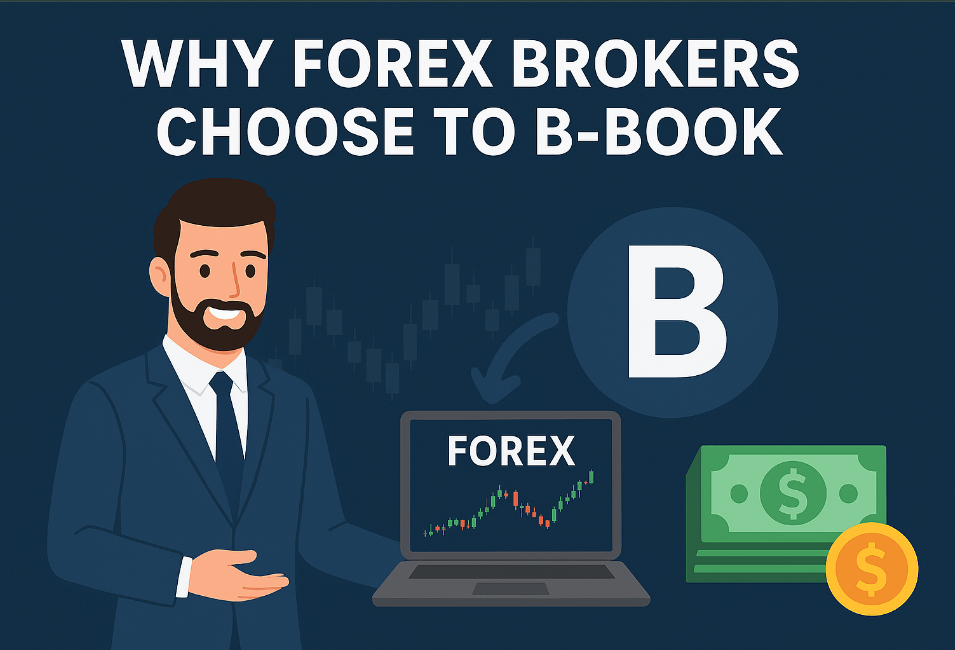
Why do brokers choose to B-Book, making the broker the counterparty to that trade? The decision boils down to financial strategy, risk management, and operational efficiency. The retail Forex market operates under two primary models for handling client trades: A-Book and B-Book. While the A-Book model routes client orders directly to a third-party liquidity provider (LP), the B-Book model is often chosen by brokers because it represents a far more potent and direct revenue source.
In This Post
Key Reasons Forex Brokers Choose B-Book
Forex brokers select the B-Book model for strategic advantages that align with their business goals. Here are the primary motivations:
1. Enhanced Profit Potential
One of the most compelling reasons for B-Booking is the direct profit from client losses. Statistically, a significant portion of retail forex traders, often cited as 70-80% end up losing money over time due to market volatility, leverage, and inexperience. By acting as the counterparty, brokers capture these losses as gains, turning client trading activity into a revenue stream beyond just spreads or commissions. This internal revenue model can lead to higher overall profitability, especially for brokers with a large base of novice traders.
2. Eliminating External Costs and Maximizing Revenue
In the A-Book model, the broker must pay an external Liquidity Provider (LP) a small fee (called a commission or markup) for executing the trade. These fees eat into the broker’s margin.
By choosing the B-Book model, brokers eliminate several costs:
- Liquidity Provider Fees: They save all the fees associated with sending orders out to a bank or LP.
- Technology Costs: They reduce or eliminate reliance on expensive bridge software and external connectivity, simplifying their infrastructure.
- Swap Fees: They can internalize the difference between the buy and sell interest rates (swaps), which can be another significant revenue stream.
This massive reduction in operating cost, means the revenue generated from the spread and client losses goes almost entirely to the broker’s bottom line.
3. Greater Control Over Execution and Client Experience
While often controversial, B-Booking also gives the broker immense control over the trading environment, which they can use to manage both risk and perceived execution quality:
- Internal Liquidity: The broker can provide deep, internal liquidity by matching client orders against one another. This allows them to offer very tight, competitive spreads.
- Controlling Slippage: In a B-Book environment, the broker has the ability to manage the price execution. While this can sometimes be used unethically, it often means the broker can offer clients rapid, reliable execution without the small delays associated with external LP communication.
- Risk Categorization: Sophisticated brokers use complex algorithms to profile clients. Profitable, high-volume traders are usually moved to the A-Book (so the broker doesn’t lose money to them), while statistically loss-making clients are kept on the B-Book.
4. Operational Ease and Startup Simplicity
For new or smaller brokers, the B-Book model is much simpler and faster to deploy. Setting up direct connections with multiple Tier 1 banks or LPs for an A-Book operation is a lengthy, complex, and costly process.
A B-Book broker essentially requires a robust trading platform (like MetaTrader) and a reliable risk management system. This lower barrier to entry makes it an attractive starting point for many firms entering the competitive Forex brokerage space.
The Trade-Off: Conflict of Interest
It’s important to note the inherent downside: When a broker B-Books your trade, a conflict of interest exists. Since your loss is their profit, the broker is theoretically incentivized to see you fail. This is why traders must always choose brokers that are well-regulated by strict authorities (like the FCA, ASIC, or CySEC), as these bodies enforce rules to prevent unethical trading practices that could lead to broker manipulation.
In summary, the choice to B-Book is a strategic business decision designed to maximize profitability based on the high failure rate of retail traders, minimize external costs, and grant the broker greater control over the internal trading environment.
Frequently Asked Questions (FAQs)
What is B-Book in forex trading?
- B-Book refers to a broker model where the broker acts as the counterparty to client trades without hedging them externally, keeping positions in-house.
Is B-Book bad for traders?
- Not necessarily while it creates a potential conflict of interest, many B-Book brokers offer competitive conditions and fast execution. However, traders should be aware of the risks and choose regulated brokers.
Why do some brokers prefer A-Book over B-Book?
- A-Book brokers avoid market risk by passing orders to liquidity providers, focusing on volume-based commissions. It’s seen as more transparent and ethical, especially for institutional clients.
Can forex brokers switch between A-Book and B-Book models?
- Yes, many use a hybrid approach, routing trades based on size, client type, or risk profile to optimize profits and minimize exposure.
How can I identify if a broker is using B-Book?
- Look for signs like fixed spreads, no commissions, or the broker labeling itself as a “market maker.” Regulatory disclosures or reviews can also provide clues.