

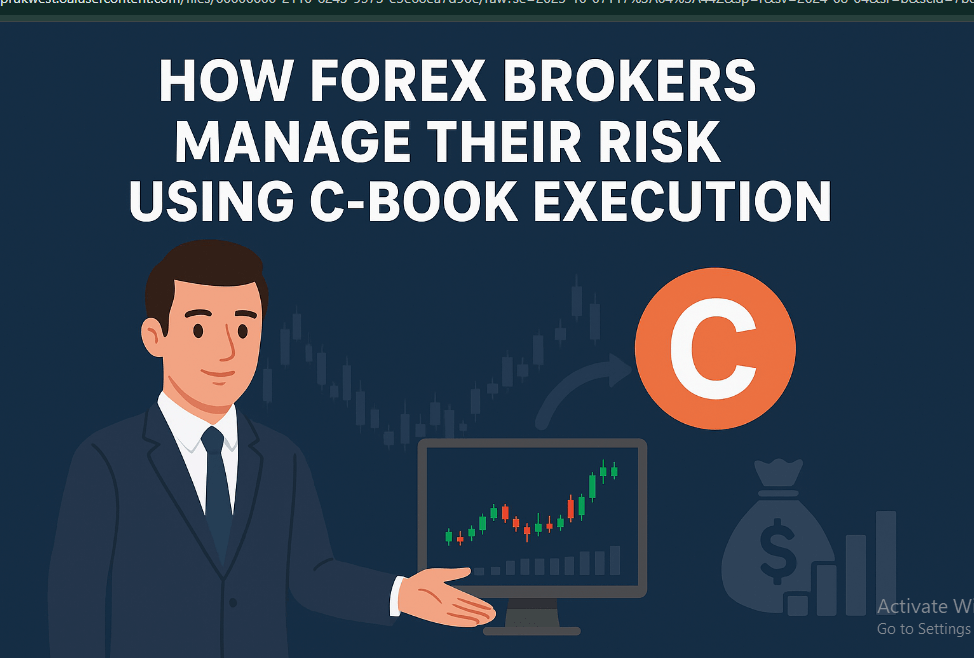
When you open a trade, your Forex broker executes it using one of two primary methods: A-Book or B-Book. But behind the scenes, a critical third component—the C-Book, actively works to secure the broker’s overall profitability and manage transactional risk. Brokers leverage C-Book to hedge risks intelligently, optimize profits, and maintain operational stability. In this article you will discover how forex brokers employ C-Book execution to safeguard their positions while capitalizing on market opportunities. Whether you trade currencies or operate a brokerage, mastering these techniques enhances decision-making in the fast-paced forex landscape.
In This Post
Defining the C-Book: The Administrative Ledger
The C-Book (or Client Book) is a designation brokers assign to trades and activities that manage the non-market related financial relationship with a client. Unlike A-Book and B-Book, which address the immediate risk of market price exposure, the C-Book focuses exclusively on operational revenue streams and administrative stability.
A broker employs the C-Book to track and allocate costs that are essential to running the business but are not directly tied to price fluctuations in the interbank market. This allows them to isolate predictable income streams.
What the C-Book Manages:
- Commissions: The flat fees the broker charges for trade execution, typically calculated on a per-lot basis. This is a highly predictable revenue stream for the broker, regardless of whether the trade is profitable or losing for the client.
- Swap (Overnight Fees): The interest the broker collects or pays for holding positions open past the daily rollover. Because swaps are based on the interest rate differential between two currencies, the broker can statistically project this income, especially when the majority of client positions incur a debit (pay interest). This recurring fee structure forms a dependable financial anchor.
- Markups: Small increments of spread the broker adds to the raw interbank price. If an A-Book trade is executed with an external Liquidity Provider (LP), the LP gives the broker a raw spread; the broker then adds a few pips of markup, which becomes a guaranteed C-Book profit.
- Withdrawal/Deposit Fees: Any processing fees the broker applies to manage the movement of funds, often compensating for banking or payment processor charges.
- Client Bonuses and Promotions: Funds the broker allocates for marketing purposes, like non-withdrawable deposit bonuses. The C-Book tracks the expense and associated liabilities of these campaigns.
By isolating these revenue and cost streams in the C-Book, the broker secures a reliable profit margin, regardless of whether a client’s trade is A-Booked (risked externally) or B-Booked (risked internally).
C-Book in Broker Risk Management
Brokers rely on the C-Book to buffer their operations against unexpected market or operational losses. It serves as a powerful tool for financial stability:
- Stabilizing Revenue: When a broker uses the A-Book model, their profit is only the small commission or markup. If market volatility is low, this revenue stream can shrink dramatically. The C-Book ensures that the broker earns consistent revenue through swap fees and commissions, effectively guaranteeing income even when trading volumes or price spreads are lean. This predictable income stream cushions the broker from the high unpredictability of market-based P/L, creating a more stable business model.
- Managing Non-Market Risk: The C-Book allows the broker to segregate administrative costs from trading profits and losses. Brokers use this book to ensure that their significant operational overhead such as technology expenses (e.g., MT4/MT5 platform licensing and bridge costs), regulatory and legal fees, and marketing campaign budgets are consistently covered by reliable fee-based income. This careful segregation prevents back-office costs from eroding the capital set aside for covering trading liabilities.
- Operational Clarity: By separating market P/L from transactional P/L, the broker can analyze exactly where their money is coming from. This clarity empowers the management team to adjust key performance indicators. For example, if data shows certain currency pairs generate high net swap interest, the broker may choose to market those pairs more aggressively. This allows the firm to optimize its total business performance based on concrete metrics, making their operation more resilient and data-driven.
The Relationship: A-Book, B-Book, and C-Book
It’s crucial to understand that a broker’s risk policy usually involves all three models working together in a sophisticated Hybrid structure:
- A-Book & B-Book: These determine the broker’s market exposure and manage the core financial risk related to the trade’s outcome (profit or loss).
- C-Book: This overlays both the A-Book and B-Book, applying the consistent fees, swaps, and commissions that generate predictable, stable revenue for the firm.
For instance, a highly successful trader who is A-Booked will still generate consistent C-Book revenue (commissions/markups), which covers the broker’s cost of passing that risk externally. A client whose trades are B-Booked will provide C-Book revenue plus the statistical market profit from their trading losses. A responsible broker uses the C-Book not to make a profit from client losses, but to ensure that core operations remain solvent and profitable, allowing them to focus on providing high-quality execution services.
Potential Drawbacks and Considerations
Despite its strengths, C-Book poses challenges that brokers must navigate carefully. Incorrect profiling can amplify losses, as over hedging or reverse strategies backfire during unexpected market shifts. Brokers face regulatory scrutiny in strict jurisdictions, requiring transparent disclosures to avoid conflicts of interest. Traders may encounter inconsistent execution, like requotes, impacting trust. Ethical brokers mitigate these by investing in robust analytics and complying with standards.
Frequently Asked Questions
Does C-Book affect my trade price?
- No the C-Book generally does not influence the entry or exit price of your trade. The price you receive is determined by the A-Book (external LP price) or B-Book (internal market maker price). The C-Book only tracks the fees, swaps, or commissions applied to the trade after execution as a separate ledger entry.
Is the C-Book model unethical or illegal?
- Absolutely not. The C-Book is a standard, necessary part of any brokerage’s operational accounting and financial record-keeping. It simply records the fees and administrative items that cover the broker’s overhead. The ethics concern arises only with the B-Book (where the broker bets against the client) and is managed by regulation, but the C-Book itself is ethically neutral and essential for solvency.
If I only make small trades, will I be C-Booked?
- The term C-Booked applies to all clients equally, regardless of trade size or outcome. Every single trade you place whether it is A-Booked or B-Booked, incurs a commission or spread markup, and potentially swap fees. These transactional costs are universally recorded and managed in the C-Book.
How does the C-Book help manage risk from A-Booked trades?
- When a broker A-Books a trade, they pass the market risk to an external LP. The only profit the broker earns is the markup (a C-Book revenue). This predictable C-Book income secures the broker’s business continuity, allowing them to reliably cover their substantial operational costs and avoid losses even if the A-Booked client is highly profitable and forces the broker to pay out winnings.
Why do I sometimes see “C-Book” referenced as managing bad clients?
- This usage is typically proprietary or colloquial broker language. It may refer to accounts that are difficult to categorize in the A/B model—for instance, those who trade so infrequently or with such tiny volume that they primarily generate only fees (C-Book revenue) but have no predictable P/L for the broker to manage. In formal financial definitions, the C-Book refers exclusively to fees and administrative income.