


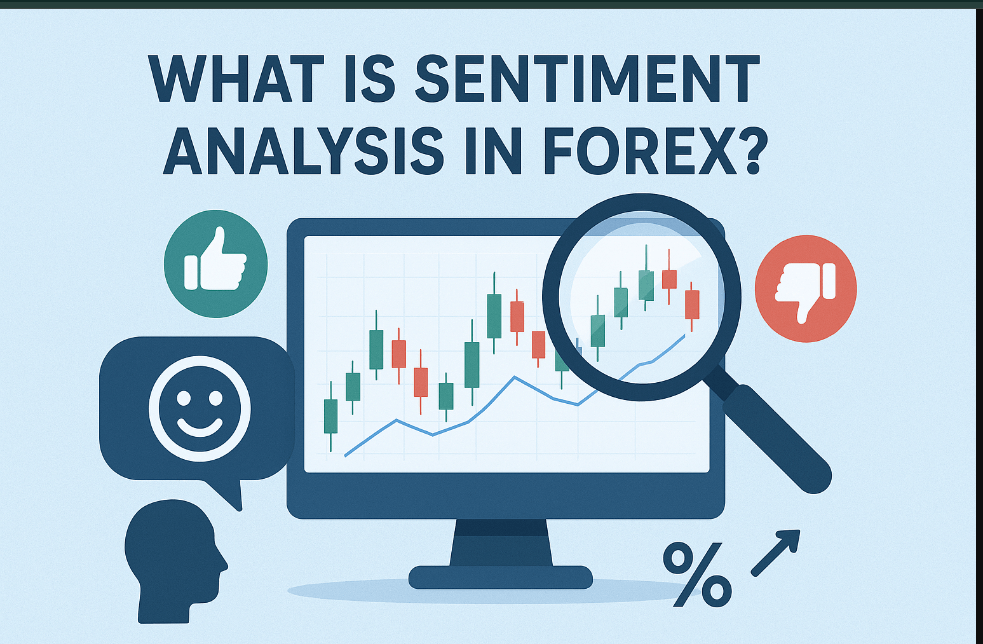
Sentiment analysis in forex is a trading approach that evaluates the overall mood or attitude of market participants toward a currency pair or the broader forex market. It focuses on gauging whether traders are predominantly bullish (optimistic) or bearish (pessimistic), helping to predict potential price movements based on collective psychology rather than just economic data or charts. Unlike fundamental or technical analysis, sentiment analysis taps into the emotional and perceptual aspects of trading, often revealing contrarian opportunities where the crowd’s view might be wrong. This method is crucial in the fast-paced forex environment, where human emotions can drive short-term volatility.
In This Post
The Concept Behind Sentimental Analysis
The core principle behind Sentiment Analysis in trading is that when sentiment reaches an extreme, the market often runs out of fuel and reverses.
Imagine the entire market is heavily bullish on the Euro against the US Dollar (EUR/USD). Nearly everyone who wanted to buy has already placed their trade. This leaves fewer potential buyers remaining to push the price higher. At this point, even a small amount of selling pressure can cause a sharp drop, as there are no buyers left to absorb the sales, and the previously bullish traders are forced to sell to cut their losses.
Sentiment Analysis, therefore, helps you identify crowded trades that are vulnerable to massive liquidations or “short squeezes.”
Key Tools for Measuring Market Sentiment
Traders do not guess sentiment; they rely on concrete data sources that reveal the live positioning of institutional and retail traders.
1. The Commitment of Traders (COT) Report
The COT Report is one of the most powerful sentiment tools. Released weekly by the U.S. Commodity Futures Trading Commission (CFTC), this report details the net long and short positions of large players in the futures market, specifically:
- Commercial Traders: Large corporations and producers who use the market to hedge risk (often trading against the trend).
- Non-Commercial Traders (Managed Money): Large hedge funds and speculative institutions (smart money). Their extreme positioning often signals a major market peak or trough.
By tracking the net positioning of these Non-Commercial Traders, analysts gain insight into where the “big money” is placing its bets, providing a long-term sentiment outlook.
2. Retail Broker Positioning Data
Many large retail Forex brokers publish sentiment indicators that show the percentage of their own client base currently holding long versus short positions for a given pair (e.g., ” of our clients are long EUR/USD”).
- Interpretation: Retail sentiment is typically used as a direct contrarian signal. If 80% of retail traders are long, the smart money may target those crowded positions, driving the price in the opposite direction to trigger mass stop-losses. This action, known as liquidity hunting, wipes out the majority of retail positions.
3. Volatility Indexes (VIX)
While not directly a Forex tool, indexes like the VIX (Volatility Index) measure the market’s expectation of future volatility, which is a key measure of fear or complacency. When the VIX is low, sentiment is often complacent or risk-on (traders are aggressively buying riskier assets). When the VIX spikes, sentiment turns fearful or risk-off (traders are seeking safe-havens).
Integrating Sentiment into Your Trading Strategy
Sentiment analysis is rarely used as a standalone strategy. Instead, traders integrate it with their technical and fundamental work to confirm or invalidate a potential trade:
- Confirmation: A trader identifies a strong buy signal on the EUR/USD using Technical Analysis (a breakout of resistance). They then check sentiment and find that retail traders are heavily short (selling). This bearish retail positioning confirms the bullish trade, as it suggests room for the price to run higher.
- Risk Check: A trader has a bullish Fundamental thesis for the Yen. However, they check the COT report and see that Managed Money is already at a historical extreme in their long Yen positions. This highly crowded trade signals that the rally may be near its end, prompting the trader to reduce their position or wait for a better opportunity.
Sentiment acts as the market’s psychological speedometer, helping you avoid dangerous, crowded turns.
Frequently Asked Questions
What is a “Crowded Trade?”
- A crowded trade is one where the overwhelming majority of market participants, typically 75% or more, are positioned on one side (either all buying or all selling). These trades are considered risky because the volume of future buyers/sellers is depleted, making the market highly vulnerable to a sudden price snap in the opposite direction.
Is Sentiment Analysis a leading or lagging indicator?
- Sentiment Analysis can be both. The COT report is considered a leading indicator when positioning reaches historical extremes, often predicting a long-term reversal. Retail positioning data, however, is often more coincident, showing you the immediate pressure or weakness in the market’s current state.
How does news affect market sentiment?
- Major news events (like unexpected changes in interest rates or sudden geopolitical conflicts) can cause instant, dramatic shifts in sentiment. For instance, a sudden move to risk-off sentiment after a major crisis will cause a sharp, immediate switch in positioning as investors dump risky assets and buy safe-haven currencies.
How long does a sentiment extreme usually last?
- There is no fixed duration. While sentiment extremes often precede reversals, they can persist for weeks or even months if a strong fundamental trend is in place. Extreme sentiment indicates the potential for a reversal, but traders must wait for a technical trigger (like a chart pattern breakdown) to confirm the shift.
What does it mean to “fade” retail sentiment?
- To fade retail sentiment means to trade against the majority position of retail traders. For example, if broker data shows 75% of retail traders are short USD/CAD, a contrarian trader will often initiate a long (buy) position, betting that the retail crowd will be wrong and that the price will eventually move up to trigger their stop-losses.