

Trend channels are a vital tool in forex trading, helping traders identify market direction, potential reversals, and profitable trading opportunities. By visually mapping price movements, trend channels provide clarity in the fast-paced world of currency trading. Whether you’re analyzing EUR/USD or USD/JPY, mastering trend channels can elevate your trading strategy. This article explains what trend channels are, how to use them, and includes practical tips to boost your forex success.
In This Post
What Are Trend Channels in Forex?
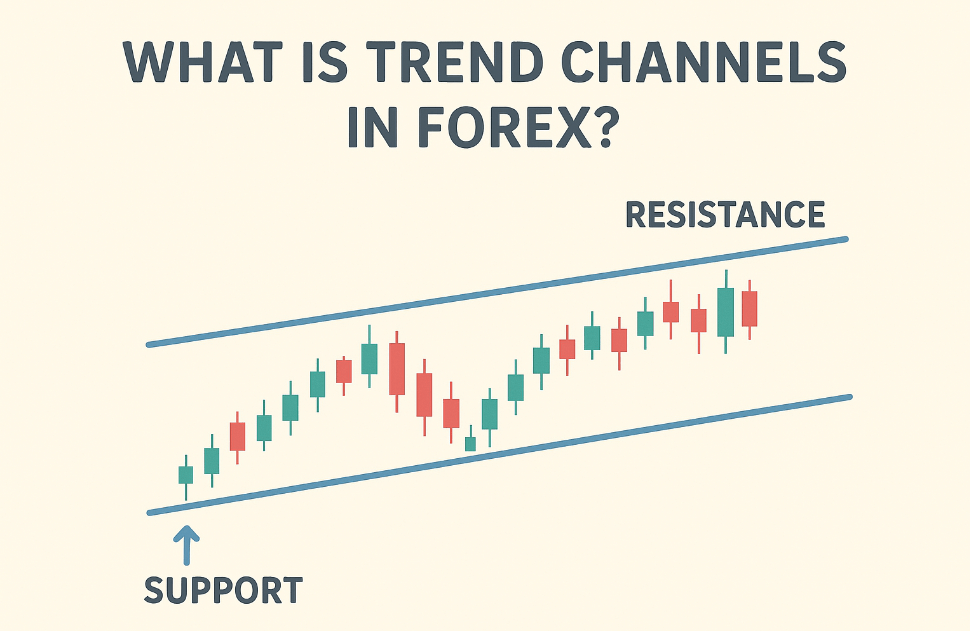
A trend channel is a technical analysis tool formed by drawing two parallel lines on a price chart to enclose price action within a trend. The lower line connects swing lows (acting as support), while the upper line connects swing highs (acting as resistance). Together, they create a “channel” that highlights the direction and range of a currency pair’s movement.
Trend channels come in three main types:
- Ascending Channel: Slopes upward, indicating a bullish trend with higher highs and higher lows.
- Descending Channel: Slopes downward, showing a bearish trend with lower highs and lower lows.
- Horizontal Channel: Flat, representing a range-bound market with no clear trend.
For example, if GBP/USD is trading between 1.3000 (support) and 1.3200 (resistance) in an ascending channel, traders can anticipate price bounces within this range.
Why Are Trend Channels Important?
Trend channels are essential for forex traders because they:
- Define Trend Direction: Clearly show whether the market is bullish, bearish, or ranging.
- Identify Trading Zones: Highlight buy zones near the lower line and sell zones near the upper line.
- Signal Breakouts: A price break above or below the channel can indicate a trend reversal or acceleration.
- Enhance Risk Management: Allow traders to set stop-losses just outside the channel for better control.
Data from trading studies suggests that channel-based strategies can improve win rates by up to 20% when combined with proper risk management.
How to Draw Trend Channels
Drawing accurate trend channels requires careful analysis. Here’s a step-by-step guide:
- Identify the Trend: Use a chart (e.g., 4-hour or daily) to determine if the market is trending up, down, or sideways.
- Draw the Main Trend Line: Connect at least two swing lows (for an uptrend) or swing highs (for a downtrend) to form the lower or upper line.
- Create the Parallel Line: Draw a second line parallel to the first, connecting the opposite swing points (highs for uptrends, lows for downtrends).
- Validate the Channel: Ensure the price respects both lines with multiple touches. The more touches, the stronger the channel.
- Adjust as Needed: Update the channel as new highs or lows form to reflect evolving market conditions.
Pro Tip: Use platforms like TradingView or MetaTrader 5 for precise line drawing and alerts. Avoid forcing channels where price action doesn’t align.
Types of Trend Channels
- Ascending Channels: Common in bull markets, ideal for buying near the lower line and selling near the upper line.
- Descending Channels: Seen in bear markets, suitable for selling near the upper line and covering shorts near the lower line.
- Horizontal Channels: Occur in range-bound markets, perfect for range trading between support and resistance.
- Wedge Channels: Narrowing channels (rising or falling wedges) often signal impending breakouts or reversals.
Trading Strategies Using Trend Channels
Trend channels are versatile and can be applied in various forex strategies:
- Range Trading: Buy at the lower channel line and sell at the upper line in horizontal or gently sloping channels.
- Breakout Trading: Enter trades when the price breaks out of the channel with high volume, signaling a new trend.
- Trend Continuation: In ascending/descending channels, trade in the direction of the trend (buy in uptrends, sell in downtrends).
- Reversal Trading: Watch for channel breaks with candlestick patterns (e.g., engulfing candles) to catch reversals.
For instance, in an ascending USD/CAD channel, a trader might buy near the lower line at 1.3600, targeting the upper line at 1.3800, with a stop-loss below 1.3550.
Common Mistakes to Avoid
Maximize your success by steering clear of these errors:
- Overdrawing Channels: Too many lines clutter charts and confuse analysis. Focus on the most significant price points.
- Ignoring Volume: Breakouts without strong volume are often false. Use volume indicators to confirm moves.
- Neglecting Timeframes: Channels on lower timeframes (e.g., 15-minute) may be less reliable than daily charts.
- Forcing Fit: Don’t adjust channels to match your bias, let price action dictate the lines.
- Overlooking Fundamentals: News events like central bank announcements can disrupt channels.
Real-World Example of Trend Channels
In early 2024, AUD/USD traded in a horizontal channel between 0.6500 (support) and 0.6700 (resistance) for several weeks. Traders profited by buying at 0.6500 and selling at 0.6700. When the price broke above 0.6700 with strong volume, it signaled a bullish breakout, leading to a rally toward 0.6900.
Advanced Tips for Using Trend Channels
- Multi-Timeframe Confirmation: Validate channels across daily, 4-hour, and 1-hour charts for higher accuracy.
- Combine with Indicators: Use RSI or Bollinger Bands to confirm overbought/oversold conditions at channel edges.
- Fibonacci Integration: Align channel lines with Fibonacci retracement levels (e.g., 50%) for stronger setups.
- Set Alerts: Use charting tools to notify you of price approaches or breaks at channel lines.
- Monitor News: Be cautious during high-impact events like Non-Farm Payrolls, which can break channels.
In conclusion trend channels are powerful tools for forex traders, offering a clear framework to navigate market trends and ranges. By mastering how to draw and trade them, you can identify high-probability setups and manage risk effectively. Practice on demo accounts, combine with other indicators, and stay disciplined to harness the full potential of trend channels.
Frequently Asked Questions (FAQs)
What are trend channels in forex trading?
- Trend channels are parallel lines drawn on a price chart to enclose price action, with the lower line acting as support and the upper line as resistance, showing the trend direction.
How do I draw a trend channel accurately?
- Connect two swing lows (for uptrends) or highs (for downtrends) to form the main line, then draw a parallel line through opposite swing points. Ensure multiple price touches for validity.
Can trend channels predict breakouts?
- Yes, a price breaking above or below a channel with high volume can signal a breakout, indicating a potential new trend or reversal. Confirm with other indicators.
What’s the difference between a trend channel and a trend line?
- A trend line is a single line showing trend direction, while a trend channel uses two parallel lines to define both support and resistance within the trend.
How do I trade trend channels effectively?
- Buy near the lower channel line in ascending channels or sell near the upper line in descending channels. Use stop-losses outside the channel and confirm with indicators like MACD.