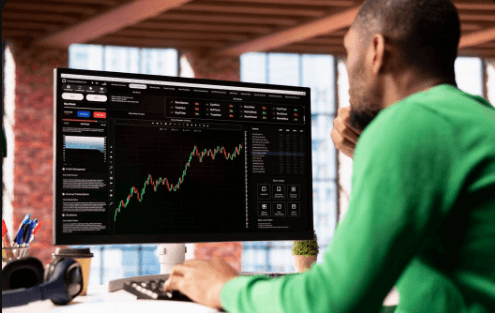
Making money trading forex is a goal that attracts millions of people worldwide. It’s a skill-based profession that requires a strategic mindset, not a get-rich-quick scheme. The core of how to make money trading forex lies in a disciplined, methodical approach that prioritizes capital preservation and consistent execution over chasing large, impulsive wins.
In This Post
How To Read a Forex Quote
1. Understanding Currency Pairs
- In forex, currencies are always quoted in pairs (e.g., EUR/USD).
- The first currency (EUR) is the base currency, and the second (USD) is the quoted currency. EUR means Euros while USD means United State Dollar
- A quote shows how much of the quoted currency is needed to buy 1 unit of the base currency. Example: EUR/USD = 1.1000 This means 1 euro = 1.10 U.S. dollars.
2. Bid and Ask Prices
- Bid price: The price at which the broker (or market) is willing to buy the base currency from you.
- Ask price: The price at which the broker is willing to sell the base currency to you.
- The difference between bid and ask is called the spread (this is essentially the broker’s fee) Example: EUR/USD = 1.1000 / 1.1003 ,1.1000 = bid (you sell euros here) 1.1003 = ask (you buy euros here) Spread = 0.0003 (or 3 pips)
3. Pips (Percentage in Point)
- A pip is the smallest price move in most currency pairs, usually the 4th decimal place (0.0001).
- Some brokers also show fractional pips (5th decimal place).
Example: EUR/USD moves from 1.1000 to 1.1005 = 5 pips gain.
4. Direct vs. Indirect Quotes
- Direct quote: Domestic currency is the quote currency (e.g., for a U.S. trader: USD/JPY = 150.00 means 1 USD = 150 yen).
- Indirect quote: Domestic currency is the base currency (e.g., EUR/USD for a European trader).
5. Interpreting a Quote
Let’s say you see:
GBP/USD = 1.2500 / 1.2504
- If you buy GBP/USD → you buy GBP, sell USD → you pay 1.2504 USD for 1 GBP.
- If you sell GBP/USD → you sell GBP, buy USD → you receive 1.2500 USD for 1 GBP.
Great Britain Pounds is abbreviated as GBP in the forex market, so do not get confused whenever you come across such abbreviations in the forex market, the currencies in the forex market are abbreviated.
Step By Step Guide on How To Make Money Trading Forex
#Step 1: Develop Your Trading Edge
Your “edge” is your unique advantage in the market. This isn’t about having insider information; it’s about having a tested strategy that has a positive expectancy. This means that, over a series of trades, your winning trades should, on average, be larger than your losing trades. The most common ways to develop an edge are:
- Technical Analysis: Analyzing price charts to identify patterns, trends, and key support and resistance levels. You use this to find high-probability entry and exit points.
- Fundamental Analysis: Studying macroeconomic events, such as interest rate decisions, inflation reports, and geopolitical news, to predict how they will affect a currency’s value.
#Step 2: Implement a Robust Risk Management Plan
This is the single most important factor for making money in forex. A professional trader’s first priority is to protect their capital, not to make a profit.
- Risk Per Trade: A golden rule for beginners is to risk no more than 1-2% of your total trading capital on a single trade. This means if you have a $1,000 account, you should not risk more than $10-$20 per trade.
- Use Stop-Loss Orders: A stop-loss is an order that automatically closes a losing trade at a predetermined price, limiting your potential loss. It’s a non-negotiable tool for every trade.
- Risk-to-Reward Ratio: This is a key metric. A good strategy should aim for a risk-to-reward ratio of at least 1:2. This means for every $1 you risk, you aim to make at least $2 in profit. By doing this, you can be profitable even if you only win 40% of your trades.
#Step 3: Execute and Review with Discipline
Once you have your strategy and risk management in place, the rest is about flawless execution.
- Follow Your Plan: Do not let emotions like fear of missing out (FOMO) or greed cause you to deviate from your trading plan.
- Keep a Trading Journal: A trading journal is a record of every trade you make, including your reasoning for entering, your emotional state, and the outcome. Reviewing this journal helps you identify patterns in your behavior and learn from both your successes and mistakes. This self-analysis is crucial for continuous improvement.
- Compound Your Gains: Instead of withdrawing profits, reinvest them. This allows your capital to grow exponentially over time, which is how a small account can eventually become a large one.
Frequently Asked Questions
How long does it take to make money trading forex?
- There is no set timeline. It can take a beginner anywhere from a few months to a year or more of consistent practice on a demo account before they can achieve consistent profitability on a live account.
Can I make money trading without a lot of capital?
- Yes, you can start with a small amount (as little as $100), but you must have realistic expectations. The percentage gains on a small account might be impressive, but the dollar amount will be modest.
What is the difference between a winning trade and a profitable strategy?
- A single winning trade is a one-time event, possibly due to luck. A profitable strategy is a set of rules that generates consistent profits over a large number of trades, even with some losses.
Is it possible to make a full-time income from forex trading?
- It is possible, but it requires significant capital, a proven track record of consistent profitability, and a disciplined approach. It is not a path for beginners and should never be seen as a replacement for a stable job in the early stages.
What is the role of a trading journal in making money?
- A trading journal helps you track your progress, identify your strengths and weaknesses, and stay accountable to your trading plan. It’s an invaluable tool for self-improvement.
How does compounding affect profitability in forex?
- Compounding allows you to grow your account exponentially. Instead of withdrawing profits, you add them to your capital, which means your next trade’s risk and potential profit are calculated on a larger base, accelerating your growth over time.