

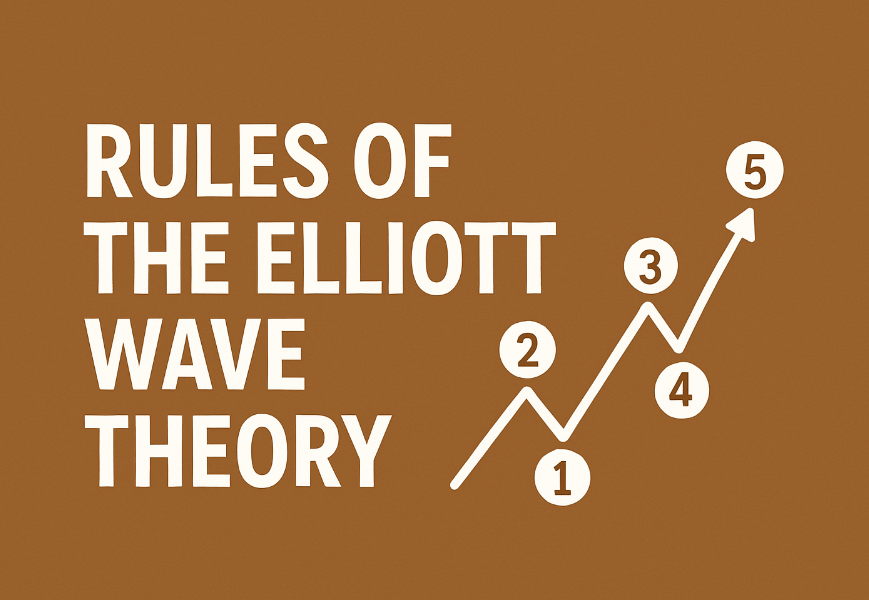
The rules of the Elliott Wave Theory are the unbreakable principles that separate valid wave counts from invalid ones. Mastering these Elliott Wave rules is essential for any trader using this method to forecast trends, reversals, and targets in forex, stocks, crypto, and commodities.
What Are the Rules of Elliott Wave Theory?
Ralph Nelson Elliott discovered that markets move in repetitive patterns driven by crowd psychology. The theory has 3 cardinal (hard) rules for impulse waves and several guidelines that occur most of the time. If any hard rule is broken, the wave count is invalid.
In This Post
The 3 Hard Rules of Impulse Waves (Must Never Be Broken)
These apply only to 5-wave impulse (motive) waves labeled 1-2-3-4-5.
Rule 1: Wave 2 Never Retraces More Than 100% of Wave 1
- Wave 2 cannot go below the starting point of Wave 1
- If it does → the entire move is corrective, not impulsive
- Most common violation by beginners
Rule 2: Wave 3 Is Never the Shortest Impulse Wave
- Among Waves 1, 3, and 5, Wave 3 can never be the shortest
- Wave 3 is usually the longest and strongest (often 161.8%+ of Wave 1)
- If Wave 3 is shortest → recount the waves
Rule 3: Wave 4 Never Overlaps the Price Territory of Wave 1
- Wave 4 low cannot enter the price range of Wave 1 (except in rare leading/trailing diagonals)
- Overlap invalidates the impulse count
- This is the “no-overlap” rule — the most frequently tested
If any of these 3 rules are violated → it is NOT a valid impulse wave.
Important Elliott Wave Guidelines (Not Rules, But Occur 80%+ of the Time)
These are strong tendencies, not absolutes:
- Alternation Guideline If Wave 2 is sharp (zigzag), Wave 4 is usually sideways (flat or triangle) — and vice versa.
- Wave 3 Extension One of Waves 1, 3, or 5 usually extends — most often Wave 3.
- Wave 4 Complexity Wave 4 is usually complex, sideways, and time-consuming.
- Channeling Impulse waves often fit inside parallel trend channels.
- Fibonacci Relationships (Very Reliable)
- Wave 2 = 50%, 61.8%, or 78.6% of Wave 1
- Wave 3 = 161.8%, 261.8%, or 423.6% of Wave 1
- Wave 4 = 38.2% or 50% of Wave 3
- Wave 5 = 61.8–100% of Wave 1 or Wave 1–3 distance
Rules for Corrective Waves (A-B-C)
Corrective waves have fewer hard rules:
- Always 3 waves (A-B-C) at minimum
- Wave B retraces 38–79% of Wave A (can exceed 100% in flats)
- Wave C is a 5-wave structure in zigzags and flats
Real-World Example: GBP/USD 2020–2021 Bull Market (Daily Chart)
- Wave 1: 1.1500 → 1.3200
- Wave 2: Retraced to 1.2200 (78.6%) — Rule 1 satisfied
- Wave 3: Explosive to 1.4200 (261.8% of Wave 1) — longest, Rule 2 satisfied
- Wave 4: Sideways to 1.3800 — no overlap with Wave 1, Rule 3 satisfied
- Wave 5: Final push to 1.4250
All 3 hard rules followed → valid impulse.
Common Violations That Invalidate Elliott Wave Counts
- Wave 4 dips into Wave 1 territory → recount as corrective
- Wave 3 shorter than both Wave 1 and Wave 5 → invalid
- Wave 2 drops below Wave 1 start → entire move is corrective (A-B-C)
How to Apply Elliott Wave Rules in Trading
- Always check the 3 hard rules first
- Use Fibonacci tools for confirmation
- Draw trend channels — Wave 4 often touches lower channel
- Wait for Wave 5 completion + divergence before reversal trades
- Never force a count — if rules break, look for alternate labeling
The rules of the Elliott Wave Theory are non-negotiable. Master the 3 hard rules for impulse waves and the key guidelines, and you’ll filter out 90% of wrong counts. Start applying them on major pairs (EUR/USD, GBP/USD) or BTC/USD using TradingView’s Fibonacci and channel tools. Correct wave counting = higher accuracy and bigger profits.
Frequently Asked Questions
What happens if Wave 4 overlaps Wave 1?
- The impulse count is invalid. It is likely a corrective structure or a diagonal (rare).
Can Wave 3 ever be the shortest?
- No, it violates Rule 2. If it appears shortest, your labeling is wrong.
Is the alternation guideline always true?
- No,it’s a guideline (80%+ occurrence). Wave 2 and Wave 4 don’t have to alternate.
What if Wave 2 retraces 100% of Wave 1?
- The entire move is corrective (not an impulse). Look for A-B-C instead.
Are the 3 hard rules enough to trade Elliott Waves?
- Yes for validation, but combine with Fibonacci ratios, volume, and channeling for high-probability trades.