

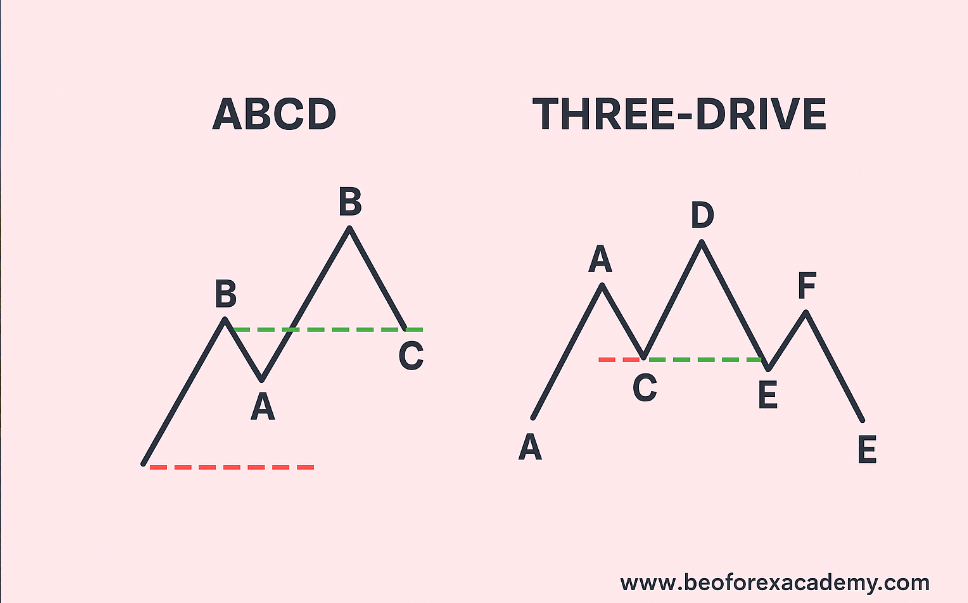
The ABCD and Three-Drive are two of the most basic and effective harmonic price patterns in forex, stock, and cryptocurrency trading. Both use precise Fibonacci ratios to detect high-probability reversal or continuation zones with symmetrical structures. Mastering the ABCD and Three-Drive patterns provides traders clean, repeatable setups with outstanding risk-reward ratios (typically 1:3 or better).
In This Post
What is the ABCD Pattern?
The ABCD pattern is the foundational harmonic structure, a four-point (A-B-C-D) symmetrical pattern that can be bullish or bearish.
- Bullish ABCD: Forms at market bottoms → price reverses up at D
- Bearish ABCD: Forms at market tops → price reverses down at D
It is essentially a simplified Gartley without the extra XA leg requirement.
ABCD Pattern Rules (Must Be Exact)
- AB leg = CD leg in time and price symmetry
- BC retracement:
- 61.8% or 78.6% of AB (most common)
- Sometimes 38.2% or 50%
- CD projection:
- 127.2% or 161.8% extension of BC
- Or 100% of AB (perfect symmetry)
When BC retracement and CD extension align at the same price zone → Potential Reversal Zone (PRZ) forms at D.
What is the Three-Drive Pattern?
The Three-Drive is a reversal pattern consisting of three symmetrical drives (impulses) separated by two corrections. It is Scott Carney’s improvement on the classic ABCD.
- Bullish Three-Drive: Three downward drives → reversal up at third drive
- Bearish Three-Drive: Three upward drives → reversal down at third drive
It signals exhaustion after three failed attempts to continue the trend.
Three-Drive Pattern Rules
- Three symmetrical impulse waves (drives)
- Each drive roughly equal in price and time
- Retracements between drives: 61.8% or 78.6%
- Final drive completes at 127.2% or 161.8% extension of A-B (first drive)
- Often shows RSI or MACD divergence at the third drive
Very powerful at market tops/bottoms.
ABCD vs Three-Drive: Key Differences
- ABCD: 4 points, single retracement + extension → continuation or reversal
- Three-Drive: 3 full drives (6 points), shows exhaustion → pure reversal pattern
- Symmetry: Both require visual symmetry, but Three-Drive is stricter (3 equal legs)
- Frequency: ABCD more common, Three-Drive rarer but higher accuracy
Both use the same core Fibonacci levels: 0.618, 0.786, 1.272, 1.618.
How to Identify ABCD and Three-Drive Patterns
Step-by-Step for ABCD
- Spot strong impulse (AB)
- Measure BC retracement (61.8–78.6%)
- Project CD extension (127.2–161.8% of BC)
- Confirm D zone confluence
- Wait for reversal candle at D
Step-by-Step for Three-Drive
- Identify first drive down/up (A–B)
- Wait for 61.8–78.6% retracement
- Second and third drives should be symmetrical
- Third drive completes at 127–161.8% extension of first drive
- Look for divergence + reversal signal
Use Fibonacci tools and harmonic indicators (ZUP, Harmony) on TradingView/MT4.
How to Trade ABCD and Three-Drive Patterns
Bullish Setup (Both Patterns)
- Enter long at D (or third drive completion)
- Stop-loss: 5–15 pips below D/X
- Take-profit:
- TP1: 38.2% retracement of CD
- TP2: 61.8% retracement of CD
- TP3: Point C or higher
Bearish Setup
- Enter short at D/third drive
- Stop above D
- Targets at 38.2% and 61.8% of CD
Risk-Reward: Usually 1:2 to 1:5
Real-World Example: Bullish ABCD on EUR/USD (2024)
- A: 1.0500
- B: 1.0950
- C: 1.0750 (61.8% retracement)
- D: 1.0600 (127.2% extension of BC) → Price reversed sharply → 400+ pip rally
Real Example: Bearish Three-Drive on GBP/JPY (2025)
- Three upward drives from 180.00 → 195.00
- Each retraced ~70.7%
- Third drive completed at 161.8% extension → Price collapsed 800 pips
Advantages and Limitations
Advantages:
- Very high accuracy when ratios align
- Clear invalidation levels
- Works on all timeframes
Limitations:
- Requires exact ratios (subjective)
- Fewer setups than classic patterns
- Can fail in very strong trends
The ABCD and Three-Drive are two of the cleanest harmonic patterns for catching reversals and continuations. Focus on 61.8/78.6 retracements and 127.2/161.8 extensions when they converge, you have a high-probability PRZ. Start scanning major pairs (EUR/USD, GBP/USD, USD/JPY) on H4/Daily charts. With practice and proper confirmation, these patterns deliver consistent 1:3+ reward-to-risk trades.
Frequently Asked Questions
Which is more accurate: ABCD or Three-Drive?
- ABCD appears much more frequently. Three-Drive is rarer but often more accurate at major tops/bottoms.
Do ABCD and Three-Drive patterns repaint?
- No, they are price-based geometric patterns. Only poorly coded indicators repaint.
What’s the best timeframe for these patterns?
- H4 and Daily, cleanest ratios and highest accuracy. M15–H1 possible but noisier.
Can I trade ABCD as a continuation?
- Yes, if CD = 100% of AB (perfect symmetry), it often continues the trend.
How do I confirm the pattern completion?
- Wait for reversal candle (pin bar, engulfing) + RSI divergence + volume spike at D.