


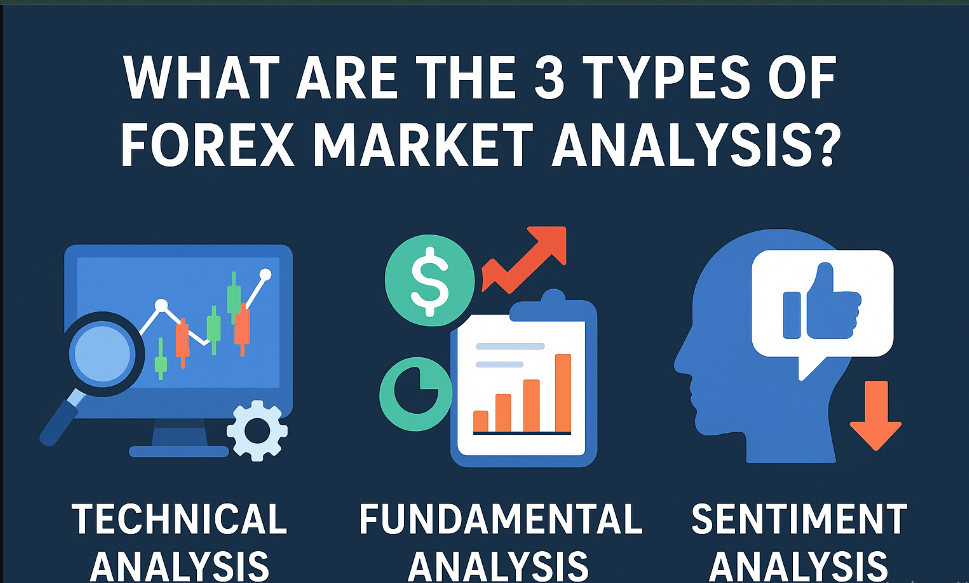
This article focuses on the three types of forex market analysis. Successful Forex trading is rooted in sound decision-making, and this process begins with market analysis. To forecast where currency prices will move, traders rely on three distinct yet complementary methods of analysis. Understanding these three approaches—Technical, Fundamental, and Sentiment, is the cornerstone of developing any robust trading strategy.
In This Post
3 Types of Forex Market Analysis
1. Technical Analysis
Technical Analysis is the study of past market data, primarily price and volume, to predict future price movements. Technical traders believe that all current information is already reflected in the price of the currency pair and that historical price patterns tend to repeat themselves.
Key Tools and Concepts:
- Chart Patterns: Traders look for classic formations like the Head and Shoulders, Double Tops/Bottoms, and Triangles to predict reversals or continuations.
- Indicators: Tools like the Moving Average Convergence Divergence (MACD), Relative Strength Index (RSI), and Bollinger Bands help traders identify overbought/oversold conditions, momentum, and volatility.
- Support and Resistance: These are key price levels where buying (support) or selling (resistance) pressure has historically been strong enough to prevent the price from moving further.
Benefits
- Works well in short-term trading strategies like scalping or day trading.
- Relies on objective data, reducing emotional decision-making.
- Applicable across various timeframes and currency pairs.
Drawbacks
- May produce false signals in volatile markets.
- Requires learning complex tools and indicators.
2. Fundamental Analysis
Fundamental analysis focuses on economic, political, and social factors that influence currency prices. Traders analyze macroeconomic indicators, news events, and geopolitical developments to assess a currency’s strength or weakness.
Key Features of Fundamental Analysis:
- Economic Indicators: Data like GDP, inflation, interest rates, and employment reports impact currency values.
- Central Bank Policies: Decisions by central banks, such as the Federal Reserve or European Central Bank, affect exchange rates.
- Geopolitical Events: Political stability, trade agreements, or conflicts can cause currency fluctuations.
- Economic Calendars: Traders use these to track upcoming events like Non-Farm Payrolls or CPI releases.
Benefits
- Ideal for long-term trading strategies.
- Helps understand the “big picture” of currency movements.
- Useful for predicting major market shifts driven by economic news.
Drawbacks
- Requires understanding complex economic relationships.
- May not be effective for short-term price movements.
3. Sentiment Analysis
Sentiment analysis gauges the overall mood or psychology of the market to predict price movements. It assesses whether traders are bullish (expecting prices to rise) or bearish (expecting prices to fall).
Key Features of Sentiment Analysis:
- Market Positioning: Tools like the Commitment of Traders (COT) report show how large traders (e.g., hedge funds) are positioned.
- Retail Sentiment: Platforms like MetaTrader or brokers’ sentiment indicators show the percentage of retail traders long or short on a currency pair.
- News and Social Media: Sentiment can be influenced by news headlines or discussions on platforms like X.
- Contrarian Approach: Many traders use sentiment data to take the opposite position of the majority, assuming the crowd is often wrong.
Benefits
- Provides insight into market psychology and potential reversals.
- Complements technical and fundamental analysis.
- Useful for identifying overcrowded trades.
Drawbacks
- Can be subjective and harder to quantify.
- Requires careful interpretation to avoid misjudging market trends.
Why Use All Three Types of Analysis?
While each type of analysis is powerful on its own, combining technical, fundamental, and sentiment analysis creates a more robust trading strategy. For example:
- Technical Analysis helps time entries and exits.
- Fundamental Analysis provides context for long-term trends.
- Sentiment Analysis reveals whether the market is overbought or oversold.
By integrating these approaches, traders can make more informed decisions and adapt to changing market conditions.
How to Apply Forex Market Analysis
- Choose Your Trading Style: Scalpers may prioritize technical analysis, while swing traders might focus on fundamentals.
- Use Reliable Tools: Platforms like MetaTrader 4/5, TradingView, or Bloomberg offer charting and economic data.
- Stay Updated: Follow economic calendars and market news to align your analysis with current events.
- Practice Risk Management: Use stop-loss orders and proper position sizing to protect your capital.
- Test Your Strategy: Backtest your analysis on a demo account to refine your approach.
Frequently Asked Questions
Which type of analysis is the best for a beginner?
- Beginners should start with Technical Analysis. Price charts are immediately visual and easier to interpret than complex economic data. Learning basic chart patterns and indicators first will allow you to practice executing trades and managing risk before diving into the complexities of global economics.
Can I successfully trade using only Technical Analysis?
- Yes, many successful traders, particularly scalpers and short-term day traders, focus almost exclusively on Technical Analysis. These strategies seek to exploit short-term price fluctuations and chart patterns, often ignoring the longer-term fundamental narrative. However, ignoring major fundamental events (like central bank meetings) is risky and requires strict risk management.
How often should I check Fundamental data?
- The frequency depends on your trading style. Swing traders and position traders should review key data releases (NFP, CPI, Interest Rate decisions) weekly or monthly. Intra-day traders should check an economic calendar daily to identify high-impact news events that could cause sudden, violent volatility.
What is the biggest challenge when using Sentiment Analysis?
- The biggest challenge is that sentiment is often a lagging indicator and can remain one-sided for longer than expected. For example, if traders are short, the price may continue to rise for weeks before the eventual reversal. Traders must use sentiment only as a confirmation tool, not a primary trading signal.
What does the term “Confirmation” mean in analysis?
- Confirmation means that two or more different forms of analysis agree on the same outcome. For example, if Fundamental Analysis suggests EUR will strengthen, and Technical Analysis shows the price breaking a key resistance level, the two methods confirm the buy signal, increasing the confidence in the trade setup.