

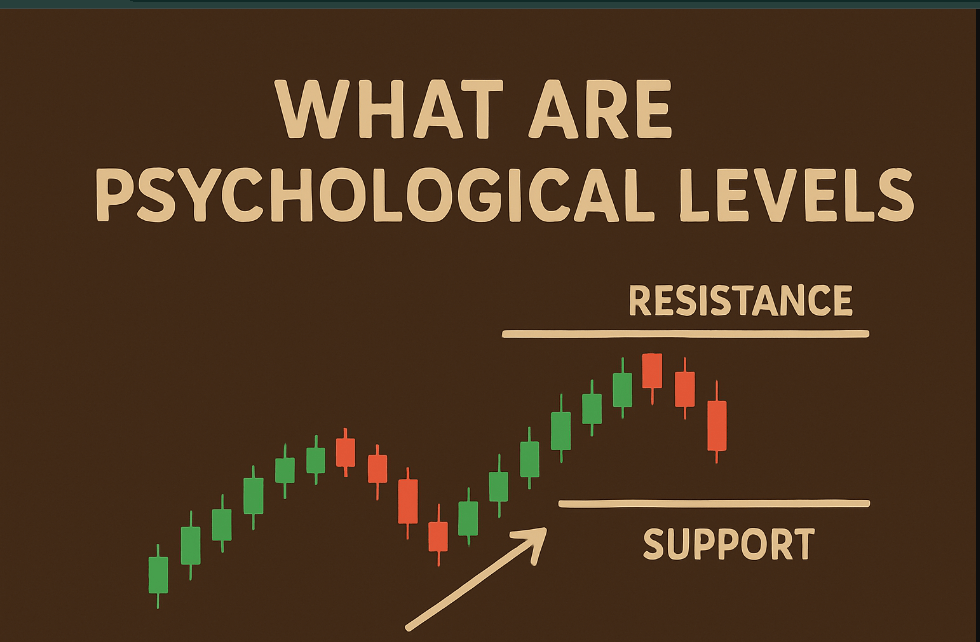
Psychological levels are critical price points in forex trading that influence market behavior due to human psychology. These levels, often round numbers, act as invisible barriers where traders make buying or selling decisions, impacting price movements. Understanding what psychological levels are can give traders an edge in predicting reversals, breakouts, or consolidations. This article explores psychological levels, their significance, and how to trade them effectively.
In This Post
What Are Psychological Levels?
Psychological levels are price points that traders gravitate toward because they are simple, memorable, and often round numbers (e.g., 1.2000 for EUR/USD or 150.00 for USD/JPY). These levels hold significance not because of technical factors but due to the collective behavior of market participants who perceive them as key benchmarks for decision-making.
For instance, if GBP/USD approaches 1.3000, traders may place buy or sell orders, expecting a reaction due to the level’s psychological weight. These levels often align with support or resistance zones, amplifying their impact.
Key characteristics of psychological levels:
- Round Numbers: Prices like 1.0000, 100.00, or 0.6500 attract attention.
- Market Focus: Traders and institutions often set orders at these levels.
- Self-Fulfilling: Their popularity makes them reliable points for price reactions.
The Origin of Psychological Levels
The effectiveness of psychological levels stems from human behavior and the way institutional players manage risk and liquidity:
1. Simplicity and Human Nature
When asked to estimate a currency’s value, or where they might want to enter or exit a trade, human traders naturally default to round, easy-to-remember numbers. No one says, “I want to sell EUR/USD at .” They say, “I want to sell at 1.1000.” This tendency creates a massive clustering of orders at these round numbers.
2. Institutional Order Placement
Large institutions (banks, hedge funds) use these round numbers as clean, easy points to place massive limit orders (pending orders to buy or sell) and stop-loss orders.
- For instance, a bank might place a large sell limit order at a major round number like 1.4000 on GBP/USD, turning that level into a formidable, self-fulfilling resistance point.
- Similarly, stop-loss orders from retail traders often congregate just above or below these round numbers, creating pools of liquidity that large players intentionally target (known as a Stop Hunt).
Types of Psychological Levels
Psychological levels are categorized based on the number of zeros they contain, which directly correlates to their strength:
- Major Round Numbers (Big Figure): These are the strongest and most significant psychological levels, typically ending in two double zeros (0000), such as 1.1500, 108.00, or 0.7000. They often represent long-term Support and Resistance levels that may hold for months or even years.
- Minor Round Numbers: These end in a single double zero (00), such as 1.1520, 1.1550, or 1.1580. These act as smaller, short-term barriers for price action and are most relevant to day traders operating on lower timeframes.
How to Trade Psychological Levels Effectively
Psychological levels are best used as areas of interest for either trade entry/exit or as confirmation for other technical signals.
1. Trading the Bounce (Confirmation Strategy)
The primary strategy is to use the Psy-Level as a confluence point. If a major level like 1.3000 on USD/CAD is approached and simultaneously lines up with a Trend Line or a Fibonacci level, it significantly increases the probability of a bounce.
- Action: When the price hits a strong Psy-Level, wait for a clear reversal candlestick pattern (like a Pin Bar or Engulfing candle) before entering the trade.
2. Trading the Breakout (Momentum Strategy)
Breaking a major psychological level often requires a significant fundamental catalyst (like a Non-Farm Payrolls report or a central bank rate hike). When the price closes decisively above or below one of these major barriers, it signals strong momentum and the formation of a new trend.
- Action: Wait for the candle to close fully past the level to confirm the breakout. Often, the level will then switch roles due to the Principle of Polarity (e.g., 1.1000 Resistance becomes 1.1000 Support), providing a high-probability retest entry.
3. Placing Stop-Losses and Take-Profits
Professional traders often use psychological levels to strategically place their protective orders.
- Stop-Losses: Never place a stop-loss exactly at a round number, as this is where other retail orders are clustered (making you vulnerable to stop hunts). Instead, place it a few pips beyond the psychological level to give your trade buffer.
- Take-Profits: Round numbers are excellent places to automatically take profit, as the price often stalls or reverses upon reaching them.
Why Are Psychological Levels Important?
Psychological levels matter because they:
- Influence Market Sentiment: Traders naturally focus on round numbers, creating clusters of orders.
- Act as Support/Resistance: Prices often stall or reverse at these levels due to high trading activity.
- Signal Breakouts: A strong move through a psychological level can trigger significant trends.
- Simplify Analysis: Easy to spot, they reduce complexity in charting.
Studies suggest that price action at psychological levels contributes to 60% of major reversals or pauses in trending markets, making them a must-know for traders.
How to Identify Psychological Levels
Spotting psychological levels is straightforward:
- Look for Round Numbers: Focus on prices ending in .0000, .5000, or .00 (e.g., 1.1000, 1.1500, 100.00).
- Check Historical Reactions: Use charts to see where price has reversed or consolidated at these levels.
- Monitor Volume: High trading volume at round numbers confirms their significance.
- Combine with Technicals: Align with support/resistance, trend lines, or Fibonacci levels for stronger signals.
- Use Multiple Timeframes: Daily or weekly charts reveal more reliable psychological levels than lower timeframes.
Tip: Platforms like TradingView or MetaTrader 5 allow you to mark these levels and set alerts for price approaches.
Combining Psychological Levels with Other Tools
To increase accuracy, pair psychological levels with:
- Candlestick Patterns: Patterns like doji or hammer at these levels signal reversals.
- Indicators: Use RSI for overbought/oversold conditions or MACD for trend confirmation.
- Fibonacci Retracements: Psychological levels often align with key Fibonacci levels (e.g., 50% or 61.8%).
- Volume Analysis: Strong volume at a psychological level validates its importance.
Mistakes to Avoid
- Assuming Infallibility: Psychological levels can break, especially during high-impact news like central bank announcements.
- Ignoring Confirmation: Don’t trade blindly, use candlestick patterns or indicators to validate setups.
- Overcomplicating Charts: Focus on major round numbers (e.g., 1.0000) rather than minor ones (e.g., 1.0230).
- Neglecting Risk Management: Always use stop-losses to protect against unexpected moves.
- Forgetting Context: Check fundamentals (e.g., economic data) that may disrupt these levels.
5 Proven Tips for Trading Psychological Levels
- Multi-Timeframe Analysis: Confirm levels on higher timeframes (e.g., weekly) for stronger signals.
- Watch Order Flow: Institutional orders often cluster at round numbers, increasing their reliability.
- Set Price Alerts: Use charting tools to notify you when price nears a psychological level.
- Backtest Setups: Test your strategy on historical data to refine entry/exit rules.
- Monitor News: Be cautious during events like Non-Farm Payrolls, which can cause volatility.
Frequently Asked Questions
Are Psychological Levels the same as regular Support and Resistance?
- They are similar, but not identical. Regular Support and Resistance are determined by historical price reversals, regardless of the number. Psychological Levels are always round numbers (, 140.00) that become powerful S&R due to the sheer volume of human and institutional orders clustered there.
How many pips away from a round number should I place my order?
- This is known as the “buffer.” To avoid false breaks and stop hunts, never place orders exactly at 1.1000. For limit entries or stop-losses, place them 3 to 10 pips above a support level or 3 to 10 pips below a resistance level, depending on the currency pair’s volatility.
Which timeframes are Psychological Levels most effective on?
- They are effective on all timeframes, but their significance increases dramatically on higher timeframes (Daily and Weekly charts). A psychological level respected on a Weekly chart indicates massive institutional participation and will often define the long-term direction of the currency pair.
What is a “Quad Zero” level?
- A Quad Zero level refers to a price point ending in four zeros, such as 1.0000 or 100.00. These are often the most powerful and significant psychological levels, representing major parity points or key milestones that often take multiple attempts to break.
Why does the price often ‘stall’ right before a major round number?
- This stalling, or consolidation, is common because major institutions may begin to fill their large limit orders before the round number is actually hit, creating a temporary wall of supply (or demand). Traders who expect the bounce also begin to close their positions prematurely, leading to indecision.