


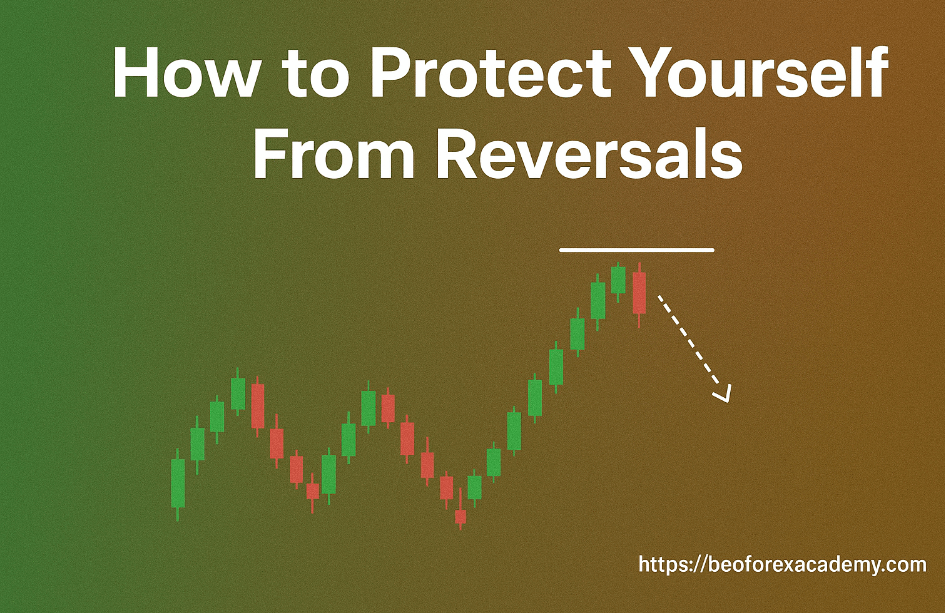
Protecting capital from an unexpected trend reversal is a core component of professional risk management. A good defense ensures that temporary market volatility does not eliminate profits or result in disproportionate losses.
The strategies below focus on limiting exposure, confirming danger signals, and utilizing effective trade management techniques.
In This Post
1. Employing the Stop-Loss Order (Mandatory Defense)
The basic and most critical defense against a reversal is the use of a well-placed stop-loss order. A stop-loss is not a goal; it is an insurance policy against the market proving your current trend assessment wrong.
- Structural Stop-Loss: The best place for a stop-loss is always beyond the last confirmed market structure point.
- Trailing Stop-Loss: Once the trade moves into profit, use a trailing stop-loss to lock in gains. Instead of maintaining the original stop, move it up (in an uptrend) or down (in a downtrend) to sit just below the most recent swing low/high. This ensures that even if the market reverses entirely, you exit with a profit.
2. Risk Reduction with Moving Averages (The Warning Line)
Moving averages serve as dynamic support and resistance, but when a significant long-term MA is broken, it signals a major shift in market psychology and serves as a critical warning line.
- The 200-Period MA Test: For traders focused on long-term trends, a decisive breach (a closing candle) of the 200-period Simple Moving Average (SMA) is often the first major sign of a potential reversal.
- Action: If your trade is still open when the price closes significantly below the 200 SMA, it is often prudent to reduce your position size by 50% or move your stop-loss immediately to break-even, even if the structural stop has not been hit yet.
3. Utilizing Divergence as an Early Warning
Divergence between price action and momentum indicators (like the Relative Strength Index or RSI, and the Moving Average Convergence Divergence or MACD) provides the earliest warning sign that the current trend is weakening and a reversal may be forming.
- Bearish Divergence (Uptrend Warning): The price makes a new high, but the indicator (RSI or MACD) makes a lower high. This suggests the buying pressure is weakening despite the price continuing to move up.
- Action: Do not immediately reverse your position, but tighten your stop-loss and cease adding to the long position. Prepare for a full exit.
- Bullish Divergence (Downtrend Warning): The price makes a new low, but the indicator makes a higher low. This suggests selling pressure is exhausting.
4. Scaling Out of Profitable Positions (Profit Protection)
To protect gains from a sharp reversal, traders should adopt a strategy of taking partial profits as key technical targets are reached, rather than waiting for one massive move.
- Targeted Scaling: When the price hits a major resistance level, a Fibonacci extension target, or a previous swing high/low, exit a portion of your position (e.g., 50% or 75%).
- Benefit: By locking in a profit, you insulate your realized gain from any sudden market reversal. The remaining position can be left with a stop-loss at break-even or better, allowing you to participate in further gains risk-free.
5. Confirmation from Multiple Time Frames
A single time frame (e.g., 1-hour chart) may show a reversal, but the bigger picture (e.g., 4-hour or Daily chart) might still be in a healthy trend. A true reversal must be confirmed across higher time frames.
- Reversal Confirmation Rule: A potential reversal on a lower time frame is only validated as a major trend change when the market structure is also broken on the next two higher time frames.
- Protection: Do not panic exit a long-term position based on a short-term pattern. Only take protective action when the higher time frame confirms the structural break.
Frequently Asked Questions (FAQs)
What is the best place to set a protective stop-loss to guard against a trend reversal?
- The best place to set a protective stop-loss is below the last confirmed swing low (Higher Low) in an uptrend, or above the last confirmed swing high (Lower High) in a downtrend. This point represents the definitive breakdown of the current market structure.
How can I use the Relative Strength Index (RSI) to get an early warning of a reversal?
- You can use the RSI to look for divergence. A warning sign of an impending trend reversal occurs when the price makes a new extreme (e.g., a new Higher High), but the RSI fails to reach a new corresponding high, instead forming a lower high. This indicates momentum is fading, despite the price action.
What does “scaling out” of a profitable trade mean, and how does it prevent loss from a reversal?
- Scaling out means taking partial profits (e.g., selling 50% of your position) as the price hits pre-determined targets. This protects you because the profits are realized and locked into your account. If an immediate and sharp trend reversal occurs, you still keep the profit from the scaled-out portion, significantly reducing the impact of the loss on the remaining position.
Why is the 200-period Moving Average (MA) important for identifying defensive exit points?
- The 200-period Moving Average is widely considered a key line between long-term bullish and bearish sentiment. A decisive close below the 200 MA in an uptrend (or above it in a downtrend) is often viewed by institutions as a major change. Breaking this level provides a strong, objective signal to tighten stops or reduce position size to protect against a full trend reversal.
Should I reverse my trading position immediately when I see divergence?
- No, divergence is only a warning sign, not an immediate trade signal. Divergence indicates that momentum is weakening, suggesting a trend reversal is possible. You should use this warning to tighten your stops and prepare for a potential exit, but you should only reverse the position once the definitive market structure break is confirmed on the chart.