
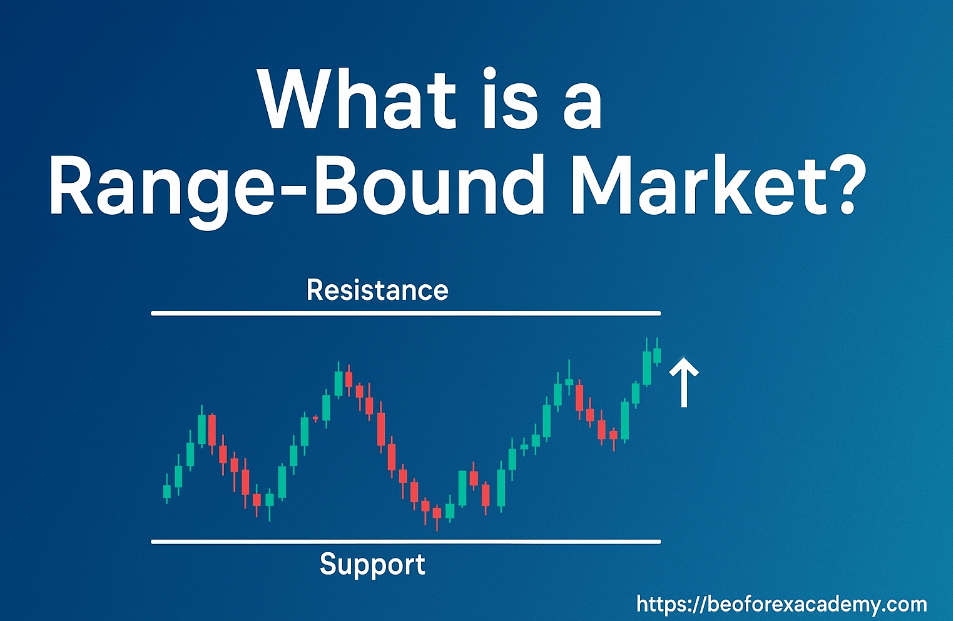
A range-bound market (also called sideways, consolidating, or choppy market) is when price oscillates between a clearly defined horizontal support and resistance without making significant higher highs or lower lows. Understanding what a range-bound market is and how to trade it is crucial because 70% of the time, markets are ranging, not trending.
In This Post
What Exactly is a Range-Bound Market?
A range-bound market occurs when:
- Price repeatedly bounces between the same support and resistance levels
- No clear trend (no higher highs/higher lows or lower highs/lower lows)
- ADX < 20–25 (low trend strength)
- Volatility contracts (Bollinger Bands squeeze)
Ranges can last from a few hours to several months. The longer and cleaner the range, the stronger the eventual breakout.
How to Identify a Range-Bound Market in 10 Seconds
Look for these 5 visual signs:
- Flat horizontal support & resistance (at least 3–4 touches each)
- Price repeatedly rejects the same levels
- Candles overlapping heavily (no clear direction)
- Moving averages are flat (20, 50, 200 EMA horizontal)
- Low volatility (small candle bodies, shrinking ATR)
Bonus confirmation tools:
- ADX below 20
- Bollinger Bands squeezed
- RSI oscillating between 40–60
Best Indicators for Confirming Range-Bound Conditions
- Bollinger Bands → Bands contract = range forming
- ADX (14) → Below 20 = no trend
- ATR (14) → Declining readings
- Horizontal Volume Profile → High volume nodes at range highs/lows
- RSI (14) → Stuck between 40–60 (no overbought/oversold extremes)
How to Trade Range-Bound Markets Profitably
Strategy 1: Buy Low, Sell High (Classic Range Trading)
- Buy near support → target resistance
- Sell/short near resistance → target support
- Stop-loss just outside the range (5–15 pips beyond)
- Risk-reward: 1:2 to 1:4
Strategy 2: Fade the Edges with Confirmation
Wait for rejection candles (pin bar, engulfing) at range extremes before entering.
Strategy 3: Range Breakout (The Big Money Move)
- Wait for strong close outside range + volume spike
- Enter in breakout direction
- Target: Range height added to breakout point
Pro tip: 80% of breakouts fail — wait for close + retest.
When NOT to Trade Range-Bound Markets
Avoid ranging markets when:
- Major news within 2 hours (NFP, CPI, FOMC)
- Range is too narrow (<50 pips in forex)
- No clear 3+ touches on support/resistance
- ADX rising above 25 (trend starting)
Real-World Examples
**
EUR/USD 2023 Summer Range
- 1.0750 support ↔ 1.1020 resistance (3 months)
- 300+ pip swings inside range → Perfect for buying 1.0780, selling 1.1000 repeatedly
BTC/USD 2024 $55k–$70k Range
- Clean horizontal levels
- Multiple fake breakouts → Range traders made 10%+ monthly while trend traders lost
Advantages and Dangers of Range-Bound Markets
Advantages
- Predictable levels
- High risk-reward
- Multiple trades per day/week
Dangers
- Fake breakouts (most common trap)
- Sudden trend breakout wipes stops
- Low volatility = smaller profits per trade
A range-bound market is your friend when you respect the boundaries and your enemy when you fight them. Master the art of buying low and selling high between clear horizontal levels and always be ready to switch to breakout mode when volume returns. Start scanning EUR/USD, GBP/USD, Gold, and NAS100 daily and you’ll spot clean ranges in minutes.
Frequently Asked Questions
How long does a range-bound market usually last?
- From a few days to several months. The average forex range lasts 4–12 weeks.
Which pairs are most often range-bound?
- EUR/CHF, NZD/USD, AUD/NZD — low-volatility “range kings”. Majors range 60–70% of the time.
Should I use stop-loss in ranging markets?
- Yes, always place stops just outside the range. Fakeouts happen constantly.
How do I know when the range is ending?
- ADX rising above 25 + Bollinger Band expansion + volume spike = breakout imminent.
Is range trading better than trend trading?
- Range trading has a higher win rate (70%+) but smaller profits. Trend trading has lower win rate but bigger moves. Most pros do both.