


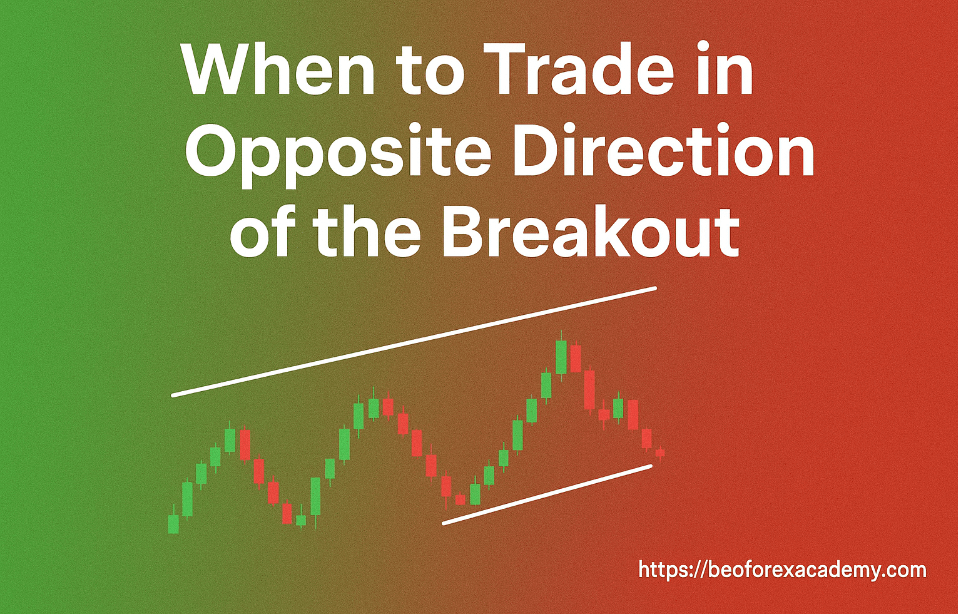
Trading in the opposite direction of an apparent breakout, known as Fakeout Trading or Trap Trading, is a powerful counter-trend strategy. It capitalizes on the failure of a majority of breakout attempts, trapping traders who entered on the initial move and forcing a sharp reversal.
This strategy should only be used after you have established clear rules for identifying a failed breakout.
In This Post
The Anatomy of a Failed Breakout (The Setup)
A failed breakout occurs when the price penetrates a key support or resistance level but quickly reverses and moves back inside the original structure. This failure signals that the initial move was not driven by strong conviction but rather by momentary market enthusiasm or stop-loss hunting.
The “Snapping Back” Candle
The most reliable sign of a fakeout is the immediate reversal candle that closes back inside the consolidation pattern or the support/resistance level.
- Bullish Fakeout (Reversal Short): The price breaks above resistance, but the candle (often with a long upper wick) closes back below the resistance line. This suggests sellers aggressively rejected the higher prices.
- Bearish Fakeout (Reversal Long): The price breaks below support, but the candle (often with a long lower wick) closes back above the support line. This indicates that buyers aggressively absorbed the selling pressure.
High Volume on Reversal
If the initial breakout occurred on low or average volume (a weak sign), the subsequent reversal back into the pattern on high volume is a powerful confirmation of the trap. High volume on the snap-back indicates that the trapped traders (who entered the breakout) are panic-selling/buying to exit their positions.
Execution Strategy: Trading the Reversal
The entry point for a fakeout trade is designed to capitalize on the momentum generated by the trapped traders reversing their positions.
The Entry Trigger
Wait for the candle that signaled the fakeout (the one closing back inside the structure) to fully close. Then, enter the trade in the opposite direction on the opening of the very next candle.
- For a Bearish Reversal (Short Entry): Wait for the price to break resistance, then close back below it. Entry is placed when the price breaks the low of the fakeout candle.
- For a Bullish Reversal (Long Entry): Wait for the price to break support, then close back above it. Entry is placed when the price breaks the high of the fakeout candle.
Stop Loss Placement (Tight Risk Management)
Because this strategy is counter-trend and relies on speed, the stop loss must be extremely tight.
- Placement: Place the stop loss just beyond the very tip of the fakeout wick (the highest high or lowest low of the reversal candle). This ensures that if the breakout attempt resumes, you are immediately taken out with minimal loss.
Profit Target
The target for a fakeout trade is often the opposite boundary of the original consolidation pattern.
- Breakout above Resistance Fails: The target is the original support level of the pattern (e.g., the bottom of the channel or triangle).
- Breakout below Support Fails: The target is the original resistance level of the pattern (e.g., the top of the channel or triangle).
High-Conviction Scenarios for Fakeout Trading
This strategy works best when combined with other indicators that suggest the initial breakout was unlikely to succeed.
Trading the Range Boundaries
Fakeouts are most common and profitable near the far edges of a well-defined trading range or channel. If the price breaks the outer edge of a long-term range, but immediately reverses, the resulting move back to the range center (or the opposite boundary) can be very sharp.
Key Moving Average Rejection
If a breakout occurs against a major Moving Average (e.g., the 200 EMA on a Daily chart), and then the price snaps back inside, this signals that the larger trend (represented by the MA) is still dominant and the breakout was only temporary market noise.
Divergence in Momentum
If the price makes a new high/low (the breakout) but a momentum oscillator like the RSI (Relative Strength Index) or MACD fails to make a corresponding new high/low (creating divergence), the momentum is already weak. A subsequent fakeout confirmation makes the reversal trade highly reliable.
Frequently Asked Questions (FAQs)
Is Fakeout Trading the same as “selling high” and “buying low”?
- While it involves selling near a high (resistance) or buying near a low (support), Fakeout Trading is more specific. It’s not just about selling at resistance; it’s about selling when resistance is successfully broken and then immediately fails. This failure traps buyers, creating the powerful momentum required for the reversal trade.
On which timeframe is the fakeout strategy most reliable?
- Fakeout trading is most reliable on the Daily (D1) and 4-Hour (H4) timeframes. The movements on these higher timeframes represent greater institutional commitment. When a fakeout occurs on a daily chart, the conviction behind the reversal is strong enough to fuel a multi-day move. Avoid using this strategy on timeframes lower than 1 hour.
What is the risk-to-reward ratio for a typical fakeout trade?
- Fakeout trades often offer excellent risk-to-reward ratios, typically 3:1 or higher. Because the stop loss is placed tightly just beyond the wick of the failed candle, and the target is the opposite boundary of the consolidation pattern (which can be wide), the potential reward often significantly outweighs the small risk taken.
Should I use pending orders or market orders for entry?
- It is generally better to use a market order immediately after the reversal candle closes, or a stop limit order placed just above (for a long entry) or just below (for a short entry) the high/low of the reversal candle. Since speed is crucial, waiting for the subsequent candle to confirm the reversal ensures you catch the momentum shift.
What is the biggest danger in trading fakeouts?
- The biggest danger is confusing a genuine breakout (which pulls back shallowly for a re-test before continuing) with a fakeout. If you prematurely enter the reversal trade, and the market successfully continues the breakout, your tight stop loss will be hit immediately. Always wait for the price action to close back inside the original structure to confirm the move has failed.